
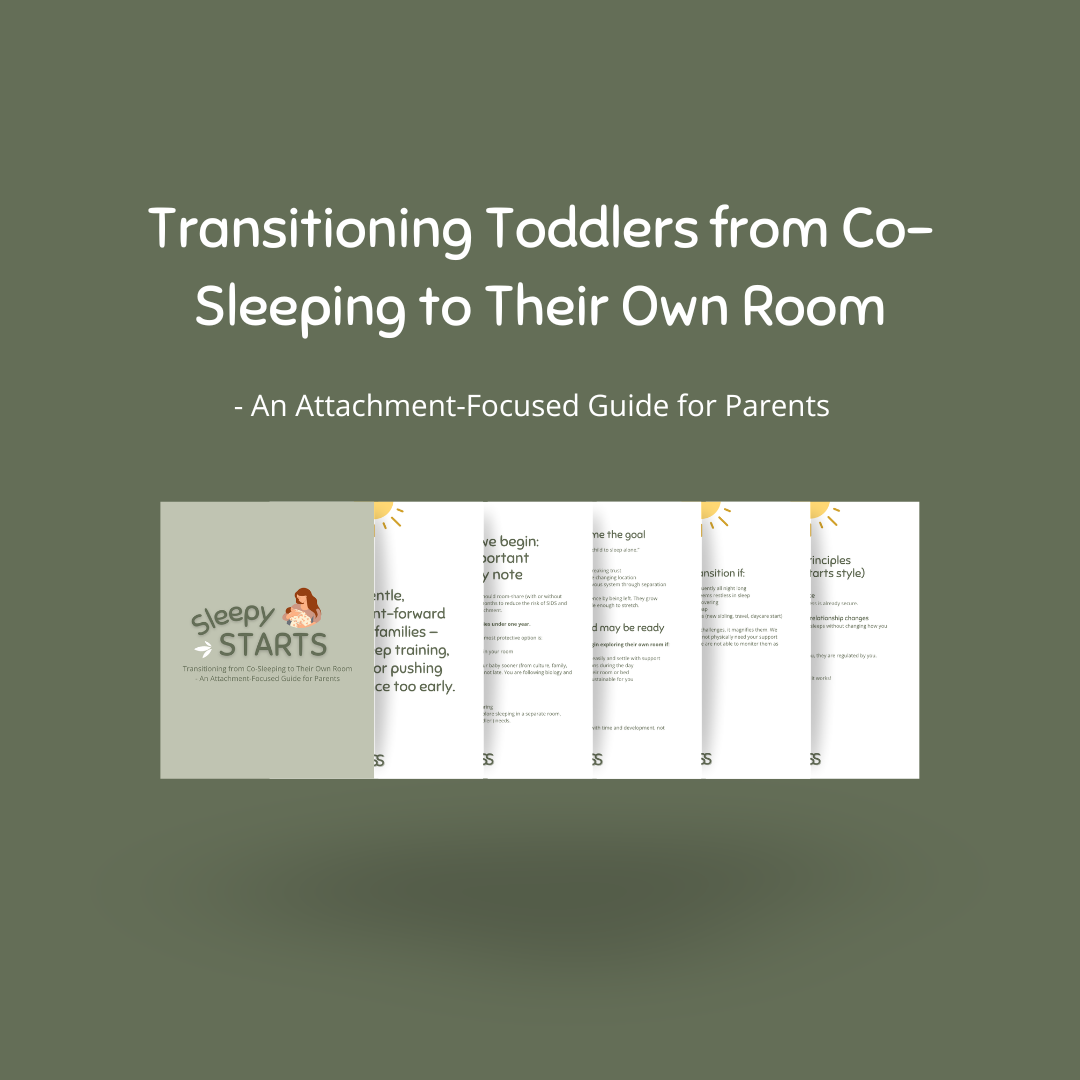
 Image 1 of 3
 Image 2 of 3
 Image 3 of 3
A Gentle, Attachment-Forward Guide (12 Months+)
Moving your child from co-sleeping to their own room can feel emotional, overwhelming, and confusing. Especially when you don’t want sleep training, cry-it-out, or rushed independence.
This guide was created for families who have been bedsharing or co-sleeping and are beginning to explore sleeping in a separate room, without breaking trust or ignoring their child’s emotional needs.
Rooted in attachment science, infant nervous system development, and current safety guidance, this resource walks you through how to change location without changing your responsiveness.
No pressure, timelines, or forcing independence before your child is ready.
This guide is not intended for babies under 12 months.
The American Academy of Pediatrics (AAP) recommends room-sharing (with or without bedsharing) for at least the first year of life to reduce the risk of SIDS.
This resource honors that recommendation and is designed only for toddlers 12 months and older.
Your child is 12 months or older
You’ve been co-sleeping or bedsharing
Bedsharing has felt supportive emotionally, but no longer sustainable physically or logistically
You want to transition to your child’s own room, not just a different sleep surface
You want to stay responsive, connected, and attachment-focused
You do not want sleep training, timed check-ins, or crying alone
Your baby is under 12 months
You’re looking for a fast, independence-focused sleep solution
You want a rigid plan or guaranteed timelines
Clear guidance on when not to attempt this transition
Signs your child may be developmentally ready
A gentle, step-by-step progression you can move through at your own pace
How to start with the first stretch of the night
Why parent presence in your child’s room is often the missing piece
What real progress looks like (and why it isn’t linear)
Reassurance around regressions, night wakings, and emotional responses
Language and mindset shifts to reduce guilt, fear, and pressure
This guide centers the truth many parents aren’t told:
Moving rooms is a relationship transition, not a sleep milestone.
Attachment-led, not behavior-based
Rooted in nervous system regulation, not sleep training
Honors both child safety and parental needs
Written for real families, not idealized sleepers
A Gentle, Attachment-Forward Guide (12 Months+)
Moving your child from co-sleeping to their own room can feel emotional, overwhelming, and confusing. Especially when you don’t want sleep training, cry-it-out, or rushed independence.
This guide was created for families who have been bedsharing or co-sleeping and are beginning to explore sleeping in a separate room, without breaking trust or ignoring their child’s emotional needs.
Rooted in attachment science, infant nervous system development, and current safety guidance, this resource walks you through how to change location without changing your responsiveness.
No pressure, timelines, or forcing independence before your child is ready.
This guide is not intended for babies under 12 months.
The American Academy of Pediatrics (AAP) recommends room-sharing (with or without bedsharing) for at least the first year of life to reduce the risk of SIDS.
This resource honors that recommendation and is designed only for toddlers 12 months and older.
Your child is 12 months or older
You’ve been co-sleeping or bedsharing
Bedsharing has felt supportive emotionally, but no longer sustainable physically or logistically
You want to transition to your child’s own room, not just a different sleep surface
You want to stay responsive, connected, and attachment-focused
You do not want sleep training, timed check-ins, or crying alone
Your baby is under 12 months
You’re looking for a fast, independence-focused sleep solution
You want a rigid plan or guaranteed timelines
Clear guidance on when not to attempt this transition
Signs your child may be developmentally ready
A gentle, step-by-step progression you can move through at your own pace
How to start with the first stretch of the night
Why parent presence in your child’s room is often the missing piece
What real progress looks like (and why it isn’t linear)
Reassurance around regressions, night wakings, and emotional responses
Language and mindset shifts to reduce guilt, fear, and pressure
This guide centers the truth many parents aren’t told:
Moving rooms is a relationship transition, not a sleep milestone.
Attachment-led, not behavior-based
Rooted in nervous system regulation, not sleep training
Honors both child safety and parental needs
Written for real families, not idealized sleepers